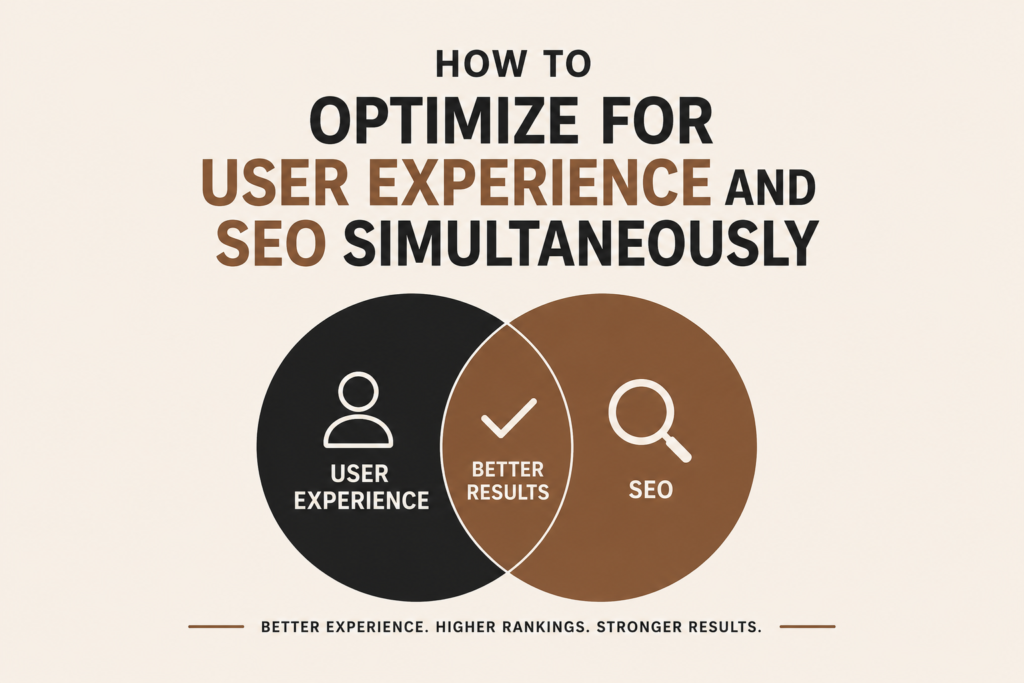
How to Optimize for User Experience and SEO Simultaneously

In the modern digital landscape, search engine optimization (SEO) and user experience (UX) are no longer separate strategies. Search engines increasingly prioritize websites that provide valuable, fast, and engaging experiences for users. For digital marketing experts, balancing SEO performance with exceptional user experience is essential for improving search visibility, increasing engagement, and driving long-term conversions.Google’s evolving algorithms now focus heavily on user-centric ranking factors. Metrics such as page speed, mobile responsiveness, content relevance, navigation structure, and engagement signals directly influence search rankings. This means websites optimized only for search engines—but not for users—are unlikely to achieve sustainable success.One of the most critical aspects of combining UX and SEO is website speed and performance. Slow-loading websites negatively impact both user satisfaction and search rankings. Visitors expect pages to load quickly, and delays often lead to higher bounce rates and lower engagement. Optimizing images, reducing unnecessary scripts, leveraging browser caching, and improving server response times can significantly enhance both performance and SEO outcomes.Mobile optimization is equally important. With the majority of users accessing websites through mobile devices, Google prioritizes mobile-friendly experiences through mobile-first indexing. Responsive design, touch-friendly navigation, and fast mobile performance are essential for improving usability and maintaining strong organic visibility.Content quality also plays a central role in both UX and SEO. Search engines reward content that is informative, relevant, and aligned with user intent. At the same time, users prefer content that is easy to read, visually structured, and engaging. Digital marketers should focus on creating clear headlines, concise paragraphs, interactive elements, and scannable content formats that improve readability while supporting keyword optimization.Website navigation and structure significantly influence user behavior and search engine crawling. A well-organized website helps users find information quickly while enabling search engines to index pages efficiently. Logical site architecture, intuitive menus, breadcrumb navigation, and strategic internal linking improve both usability and crawlability.Core Web Vitals have become a major ranking factor in recent years. Metrics such as Largest Contentful Paint (LCP), Interaction to Next Paint (INP), and Cumulative Layout Shift (CLS) measure real-world user experience on websites. Improving these performance indicators not only enhances SEO rankings but also creates smoother and more engaging browsing experiences.User engagement signals are another important connection between UX and SEO. Metrics such as time on page, click-through rates, bounce rates, and session duration provide insights into how users interact with content. Websites that deliver valuable experiences tend to generate stronger engagement signals, which can positively influence search rankings over time.Accessibility should also be considered a core part of optimization strategies. Websites designed with accessibility in mind improve usability for all users, including individuals with disabilities. Proper heading structures, image alt text, keyboard navigation, and readable fonts contribute to both inclusivity and SEO performance.Trust and credibility are equally important. Secure websites using HTTPS, transparent information, clear calls to action, and professional design elements help build user confidence. Search engines increasingly evaluate trustworthiness and authority as part of ranking considerations, especially for competitive industries.Ultimately, optimizing for both user experience and SEO requires a user-first mindset. Instead of focusing solely on rankings or algorithms, digital marketing professionals should prioritize creating seamless, valuable, and engaging experiences that naturally align with search engine best practices.As search engines continue evolving toward human-centered evaluation models, businesses that successfully integrate UX and SEO strategies will gain a significant competitive advantage. A website that satisfies both users and search engines is more likely to achieve sustainable organic growth, stronger engagement, and higher conversion rates in the long run.

How to Optimize for User Experience and SEO Simultaneously Read More »

Mastering Keyword Research Like a Pro

Keyword research is the foundation of every successful SEO and digital marketing strategy. For digital marketing experts, effective keyword research goes far beyond identifying high-volume search terms. It involves understanding search intent, analyzing audience behavior, evaluating competitor strategies, and uncovering opportunities that can drive highly targeted and conversion-focused traffic.In today’s competitive search landscape, ranking for broad keywords alone is no longer enough. Search engines have become more sophisticated, prioritizing content that aligns closely with user intent and provides genuine value. This makes strategic keyword research a critical process for building visibility, improving engagement, and increasing organic growth.The first step in professional keyword research is understanding user intent. Every search query reflects a specific purpose—whether informational, navigational, transactional, or commercial. Digital marketers must identify what users are actually looking for and create content that directly addresses those needs. Content aligned with intent not only improves rankings but also increases user satisfaction and conversion rates.Competitor analysis is another essential component of advanced keyword research. Studying top-ranking competitors helps marketers identify keyword gaps, content opportunities, and ranking patterns within their industry. By analyzing competitor pages, backlink profiles, and keyword positioning, marketers can develop more effective SEO strategies and discover untapped opportunities.Long-tail keywords play a significant role in modern SEO strategies. While short, high-volume keywords are often highly competitive, long-tail keywords target more specific user queries and typically deliver higher conversion potential. These keywords help attract qualified traffic from users who are closer to making purchasing decisions or seeking precise information.Keyword clustering and semantic SEO have also become increasingly important. Search engines now evaluate content context rather than exact keyword repetition. Instead of targeting a single keyword repeatedly, digital marketers should focus on related search terms, entities, and topical relevance. Building content around keyword clusters improves content depth, enhances topical authority, and strengthens search visibility across multiple related queries.Professional keyword research also requires leveraging advanced SEO tools and analytics platforms. Tools such as keyword planners, competitor analysis software, trend analysis platforms, and search console data provide valuable insights into search demand, ranking opportunities, and audience behavior. These tools help marketers make data-driven decisions instead of relying on assumptions.Search trends and seasonal behavior should also influence keyword strategies. Consumer interests change constantly based on industry developments, trends, and market demand. Monitoring trending topics and emerging search patterns allows marketers to create timely, relevant content that captures audience attention before competition increases.Voice search optimization is another growing factor in keyword strategy. As users increasingly rely on voice assistants and conversational search queries, marketers must optimize for natural language phrases and question-based searches. This shift requires a deeper understanding of conversational intent and semantic relevance.Successful keyword research is not a one-time activity—it is an ongoing process of analysis, optimization, and adaptation. Search behavior evolves continuously, and digital marketing professionals must regularly update their keyword strategies to maintain competitiveness and relevance.Ultimately, mastering keyword research enables digital marketers to create content that not only ranks highly in search engines but also connects meaningfully with audiences. By combining user intent analysis, competitor insights, semantic SEO, and strategic content planning, businesses can build sustainable organic growth and long-term digital authority.

Mastering Keyword Research Like a Pro Read More »

How to Recover from a Google Ranking Drop

A sudden decline in Google rankings can significantly impact website traffic, lead generation, and online visibility. For digital marketing professionals, understanding the underlying causes of a ranking drop is essential for developing an effective recovery strategy. While ranking fluctuations are common, a consistent decline often signals deeper SEO issues that require immediate attention.The first step in recovering lost rankings is conducting a comprehensive SEO audit. Google ranking drops can result from multiple factors, including algorithm updates, technical website errors, poor-quality content, toxic backlinks, or increased competition. Identifying the exact cause helps marketers take targeted corrective actions instead of relying on assumptions.One of the most common reasons for ranking losses is a Google algorithm update. Search engines continuously refine their algorithms to improve user experience and content quality. Websites that rely on outdated SEO practices, thin content, or manipulative link-building strategies may experience sudden visibility declines after major updates. Monitoring industry news and comparing traffic patterns with update timelines can help determine whether an algorithm change is responsible.Technical SEO issues can also negatively affect rankings. Slow-loading pages, broken links, crawl errors, improper indexing, and mobile usability problems can reduce search engine trust and harm user experience. Conducting regular technical audits using SEO tools allows marketers to identify and resolve these issues before they significantly impact performance. Improving Core Web Vitals, optimizing page speed, and ensuring mobile responsiveness are now critical ranking factors.Content quality remains another major component of SEO recovery. Google prioritizes valuable, relevant, and user-focused content. Outdated articles, duplicate pages, keyword stuffing, or low-engagement content can weaken a website’s authority. Updating existing content with accurate information, better keyword targeting, improved readability, and enhanced user intent alignment can help restore rankings over time.Backlink profile analysis is equally important. Low-quality or spammy backlinks may trigger ranking penalties or reduce domain authority. Digital marketing experts should regularly monitor their backlink profiles, remove harmful links when necessary, and focus on earning authoritative backlinks through high-quality content, guest posting, and digital PR strategies.User experience metrics also influence modern search rankings. High bounce rates, poor navigation, intrusive ads, and low engagement signals can indicate that users are not finding value on a website. Enhancing website design, improving internal linking, and optimizing conversion pathways can positively impact both user retention and SEO performance.Another effective strategy for recovery is competitor analysis. Studying competitors who have gained visibility can reveal valuable insights into content gaps, keyword opportunities, backlink sources, and evolving search trends. This helps marketers refine their SEO strategy and remain competitive in changing search environments.Recovering from a Google ranking drop is rarely an overnight process. SEO requires consistent optimization, performance monitoring, and long-term strategic planning. Digital marketing professionals who focus on technical excellence, high-quality content, and user-centered experiences are more likely to regain and sustain strong search visibility.In an increasingly competitive digital landscape, adapting quickly to SEO changes is essential. Businesses that continuously audit, optimize, and evolve their digital marketing strategies can successfully recover from ranking declines and build stronger long-term organic growth.

How to Recover from a Google Ranking Drop Read More »

How AI is Transforming Digital Marketing

Artificial Intelligence (AI) is revolutionizing the digital marketing landscape, enabling businesses to create smarter, faster, and more personalized customer experiences. What once required extensive manual effort can now be automated and optimized through AI-powered tools and technologies. From data analysis to content generation, AI is helping digital marketers improve efficiency, boost engagement, and achieve better results with precision-driven strategies.One of the biggest advantages of AI in digital marketing is its ability to analyze massive amounts of consumer data in real time. Marketers can now understand customer behavior, preferences, and buying patterns more accurately than ever before. This allows brands to deliver highly personalized content, product recommendations, and targeted advertisements that increase conversions and customer satisfaction.AI is also transforming content marketing. Advanced AI-powered writing tools assist marketers in generating blog posts, social media captions, email campaigns, and ad copy within minutes. These tools not only save time but also help optimize content for SEO, readability, and audience engagement. As a result, marketers can focus more on strategy and creativity rather than repetitive tasks.In social media marketing, AI plays a crucial role in audience targeting, automated scheduling, sentiment analysis, and chatbot communication. Businesses can interact with customers instantly through AI chatbots, providing 24/7 support and improving customer experience. AI-driven analytics also help marketers identify trending topics and predict which type of content will perform best across different platforms.Another major impact of AI is predictive analytics. By studying past customer interactions and behavioral patterns, AI can forecast future consumer actions and market trends. This enables businesses to make data-driven decisions, improve campaign performance, and maximize return on investment (ROI). Predictive analytics also helps marketers create proactive strategies instead of reactive ones.Search engine optimization (SEO) has also evolved with AI integration. Modern SEO tools powered by AI can identify keyword opportunities, analyze competitors, optimize website content, and improve search rankings more efficiently. Voice search optimization and semantic search strategies are becoming increasingly important as AI continues to influence how users interact with search engines.Despite its many advantages, AI should not replace human creativity and emotional intelligence. The most successful digital marketing strategies combine AI automation with human-driven storytelling, branding, and strategic thinking. Marketers who adapt to AI technologies while maintaining authentic customer connections will have a strong competitive advantage in the evolving digital landscape.As AI technology continues to advance, its influence on digital marketing will only grow stronger. Businesses that embrace AI today are better positioned to stay ahead of competitors, deliver personalized experiences, and build long-term customer relationships in an increasingly digital world.

How AI is Transforming Digital Marketing Read More »

Scroll to Top